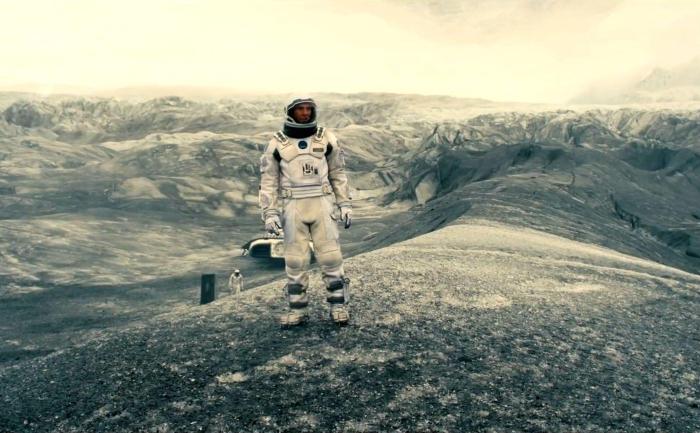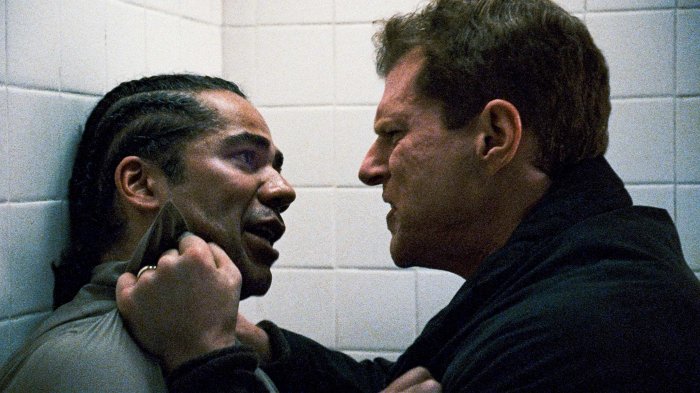

Irreversible movie scenes, pivotal moments that irrevocably alter the narrative, are explored in this comprehensive analysis. We’ll examine the characteristics that distinguish these impactful scenes from others, delving into their impact on plot, character development, and audience emotion.
This exploration will analyze the technical and visual elements used to convey irreversibility, examining examples across various genres, and comparing cinematic techniques with similar literary devices. Case studies will provide specific examples, demonstrating the profound effect of irreversible events on the narrative and characters.
Defining Irreversible Movie Scenes
An irreversible movie scene, unlike a reversible one, irrevocably alters the narrative’s trajectory and characters’ fates. These scenes are pivotal moments that reshape the plot, often with lasting consequences that cannot be undone. They are significant turning points that are foundational to the film’s overall thematic message and impact.
Characteristics of Irreversible Scenes
Irreversible scenes are distinguished by their impact on the narrative and the characters’ lives. They are not simply plot points but moments that fundamentally alter the course of the story, leaving an indelible mark on the characters’ relationships and the overall narrative. These scenes are defined by a clear, significant change, often a consequence that cannot be reversed. They are also often laden with emotional weight and psychological depth, reflecting a profound shift in the narrative.
Examples of Irreversible Scenes
Several scenes in cinematic history have been recognized for their irreversible nature. In “The Shawshank Redemption,” the protagonist’s wrongful imprisonment, while initially a setback, irrevocably sets the stage for the entirety of the film’s journey. Similarly, in “Pulp Fiction,” the violent altercation, while seemingly an isolated incident, ultimately sets off a chain of events that alters the lives of the characters.
The crucial point is that these scenes fundamentally change the trajectory of the characters and the narrative.
Comparison of Irreversible and Reversible Scenes
| Feature | Irreversible Scene | Reversible Scene |
|---|---|---|
| Plot Impact | Creates a significant, lasting impact on the plot, often altering the overall direction of the narrative and introducing a new phase. | Impacts the plot in a temporary or less substantial way; the narrative can revert to a previous state. |
| Character Development | Produces significant, often irreversible changes in character’s behavior, motivations, and relationships. | Results in temporary shifts or minor changes in character’s behavior, often with the potential for reversal. |
| Emotional Impact | Evokes strong, often lasting emotional responses from the audience, reflecting the irreversible consequences. | Can elicit a range of emotions, but the emotional impact is often less profound and temporary. |
Elements Contributing to Irreversibility
Several elements contribute to a scene’s irreversibility. A critical element is the nature of the action, often involving a significant loss, a life-altering decision, or a profound betrayal. The emotional weight of the scene, coupled with the characters’ reactions, significantly contributes to its irreversible nature. The characters’ responses, often driven by their internal conflicts and motivations, are crucial.
The consequences of the actions, both immediate and long-term, further contribute to the scene’s irreversibility. The characters’ choices, driven by their motivations, determine the scene’s lasting impact on the narrative.
Impact on Character Development
Irreversible actions, by their very nature, profoundly impact character development. These moments, often marked by choices with lasting consequences, force characters to confront their past, present, and future. The narrative shifts from a linear progression to a complex web of cause and effect, where each decision reverberates throughout the story’s trajectory. This section explores the multifaceted ways irreversible scenes reshape characters and their relationships.Irreversible events, in their dramatic impact, catalyze significant personal transformations.
The choices made, and their subsequent outcomes, reshape the character’s perception of themselves and the world around them. These shifts, though often painful, are crucial in revealing the character’s true nature and resilience. The characters’ journeys are not merely about overcoming obstacles; they are about grappling with the consequences of their actions and finding a path forward, even in the face of hardship.
Examples of Profound Alterations
Characters often undergo dramatic transformations following irreversible events. For instance, a character who commits a violent act and faces its repercussions may experience a profound loss of innocence and a shift in their moral compass. This alteration is not necessarily negative; a character might also discover hidden strengths or a newfound sense of purpose. The crucial element is the lasting impact of the irreversible act on their personality and actions.
Impact on Future Actions
Irreversible scenes shape the characters’ future actions and choices in significant ways. A character who has witnessed a tragedy or made a catastrophic decision may develop a heightened sense of caution or a profound sense of responsibility. This new perspective often dictates their future actions, making them more deliberate and thoughtful, or perhaps more impulsive and reckless, depending on the specific situation.
For example, a character who loses a loved one may dedicate their life to preventing similar tragedies, altering their life’s path significantly.
Emotional Transformations
Irreversible events can trigger a wide spectrum of emotional responses. Grief, guilt, regret, anger, and fear are common reactions. The characters may experience periods of despair or find unexpected resilience in the face of adversity. The intensity and duration of these emotional responses vary depending on the individual’s character traits and the severity of the event. These emotional transformations often become integral to the character’s arc, revealing their vulnerability and strength.
Effect on Character Relationships
Irreversible events can drastically alter relationships between characters. A betrayal, a tragic accident, or a critical choice can strain or sever bonds. Conversely, these events can also strengthen alliances and create a shared experience that deepens understanding and empathy between characters. The impact on relationships is often just as profound as the impact on the individual characters.
Table: Character Changes After Irreversible Events
| Character | Irreversible Event | Initial State | Changed State |
|---|---|---|---|
| Example Character A | Loss of a loved one | Optimistic, outgoing | Reserved, focused on preventing similar tragedies |
| Example Character B | Accidental injury to a friend | Carefree, impulsive | Cautious, dedicated to helping others |
Visual and Technical Elements
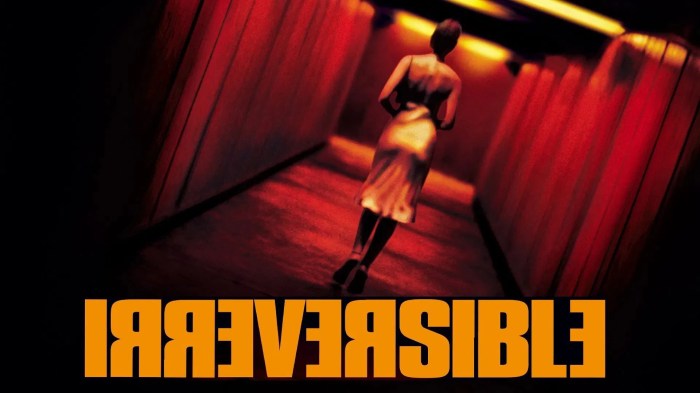
The visual and technical aspects of “Irreversible” are crucial in establishing the film’s unique narrative style and conveying the profound impact of irreversible events. The film meticulously crafts a sensory experience, employing specific techniques to heighten the emotional resonance and the sense of inescapable consequence. Through these choices, the director powerfully reinforces the theme of irreversible choices and their lasting impact.
Visual Techniques for Portraying Irreversible Events
The film employs a variety of visual techniques to portray the irreversible nature of the events. These techniques extend beyond simply showing the events themselves, aiming to create a visceral and lasting impression on the viewer. Specific visual choices amplify the sense of inevitability and the consequences of actions.
Cinematography and the Sense of Irreversibility
The cinematography in “Irreversible” often uses long takes and close-ups to immerse the viewer in the moment. This creates a feeling of immediacy and allows the audience to experience the characters’ reactions to the events unfolding. The use of deep focus, often emphasizing multiple actions happening simultaneously, highlights the complexity and interconnectedness of the story, further emphasizing the irreversible nature of events.
Framing and composition also contribute significantly, strategically emphasizing the characters’ vulnerability and the unfolding events.
Lighting and Sound Design for Irreversibility
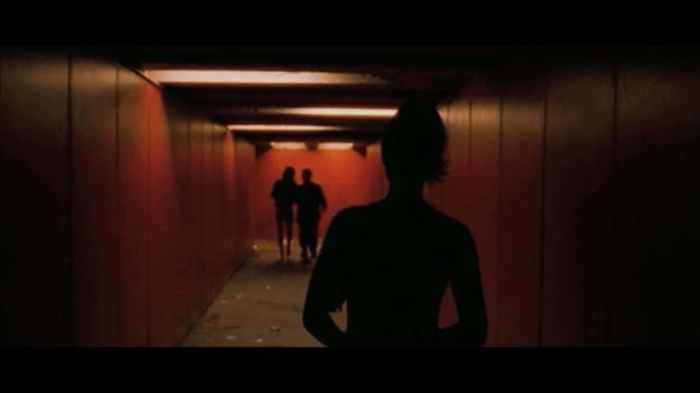
Lighting in “Irreversible” frequently employs stark contrasts and harsh shadows, particularly in scenes depicting violence and trauma. These visual elements mirror the emotional intensity and the irreversible nature of the actions. The use of low-key lighting often evokes a sense of foreboding and claustrophobia, reflecting the characters’ emotional states and the irreversible consequences of their actions. The film’s sound design plays a pivotal role.
Sound effects, music, and dialogue are carefully orchestrated to underscore the emotional weight of the scenes, contributing to the sense of irreversibility. Sudden and jarring sound effects, for example, are often employed to highlight the impact of irreversible events.
Editing and Pacing for Perception of Irreversibility, Irreversible movie scene
The film’s editing style directly impacts the perception of irreversibility. The editing often employs abrupt cuts, quick transitions, and jump cuts to mirror the chaotic and disorienting nature of the events. This style mirrors the characters’ internal turmoil and the unpredictable nature of the actions. The pacing of the film is crucial in conveying the sense of irreversibility.
Scenes are sometimes deliberately slowed down to emphasize the tension and the gradual build-up to the irreversible point. Other scenes may feature rapid-fire editing to reflect the disorientation and chaos of the unfolding events.
Significance of Setting in Irreversible Scenes
The settings in “Irreversible” are meticulously chosen to enhance the narrative’s impact and to mirror the characters’ internal states. The locations often evoke a sense of isolation, confinement, or vulnerability. This is crucial in establishing the context for the irreversible actions that take place. The settings often reflect the emotional turmoil and the consequences of the characters’ actions.
Table: Visual Elements Contributing to Irreversibility
| Visual Element | Technique | Impact on Irreversibility | Example Scene (Description) |
|---|---|---|---|
| Cinematography | Long takes, close-ups, deep focus | Creates immediacy, emphasizes multiple actions, shows complexity. | A long take during a brutal assault, focusing on the victim’s face and the assailant’s hands. Deep focus on the surrounding environment to highlight the context of the assault. |
| Lighting | Stark contrasts, harsh shadows, low-key lighting | Mirrors emotional intensity, evokes foreboding, reflects consequences. | A scene in a dimly lit, claustrophobic room, with harsh shadows cast on the characters’ faces, highlighting the tension and impending doom. |
| Editing | Abrupt cuts, quick transitions, jump cuts | Mirrors chaos, disorientation, and the unpredictable nature of the events. | Rapid-fire editing during a car chase, conveying the urgency and chaotic nature of the scene. |
| Sound Design | Sudden and jarring sound effects | Highlights the impact of irreversible events. | A sudden gunshot, immediately followed by the victim’s scream, dramatically showcasing the irreversible consequences of the act. |
Examples Across Genres
Irreversible scenes, moments of irrevocable change in a narrative, are not confined to a single genre. They resonate deeply across various cinematic styles, impacting characters and audiences in unique ways. These scenes often represent pivotal turning points, pushing characters and plots into new directions. Understanding how irreversible scenes are employed in diverse genres offers insight into the power of storytelling and its impact on viewers.
Action Genre
Irreversible scenes in action films frequently involve significant consequences for characters, often resulting from intense conflict or critical choices. These moments often involve physical trauma, loss of life, or the destruction of important assets. The immediacy and visceral nature of action scenes allow for a powerful portrayal of irreversible change. For example, a character losing a limb in a fight or a team suffering a catastrophic defeat, leading to a complete shift in their strategy or overall mission, could represent irreversible events.
The use of slow-motion or close-ups during these scenes can amplify the impact and showcase the lasting consequences.
Drama Genre
Irreversible scenes in drama frequently focus on emotional and psychological shifts. These moments often involve significant relationship breakdowns, the loss of loved ones, or the realization of a profound truth. For example, a character learning about a long-hidden family secret that forever alters their perception of their past and future, or a couple’s irreversible decision to end their relationship, exemplify irreversible change in the drama genre.
The focus is often on the emotional aftermath and the characters’ struggles to cope with the new reality. These scenes often rely on dialogue and subtle body language to convey the depth of the change.
Sci-Fi Genre
In science fiction, irreversible scenes can encompass vast changes in the universe, societal structures, or individual destinies. These moments may involve the destruction of a planet, the alteration of a character’s genetic makeup, or the irreversible consequences of a technological breakthrough. For example, a character becoming a part of a time loop, unable to change the predetermined future, or the complete eradication of a species due to unforeseen technological advancement are powerful irreversible scenes in sci-fi.
The visual effects and special effects in these genres often play a crucial role in showcasing the magnitude and finality of these changes.
Horror Genre
Irreversible scenes in horror films often center around the loss of innocence, the disintegration of sanity, or the irreversible damage inflicted upon the protagonist. These moments frequently involve violence, supernatural events, or the ultimate confrontation with a terrifying antagonist. A character being irrevocably scarred by a traumatic experience, or the destruction of a character’s home by a supernatural entity, represent irreversible scenes in the horror genre.
The atmosphere and suspense build-up in these scenes contribute to the feeling of inevitability and the permanent impact on the characters.
Table of Examples
| Genre | Irreversible Scene Example | Impact on Narrative |
|---|---|---|
| Action | A character losing an arm in a fight | Changes the character’s abilities and future actions; shifts the plot’s direction. |
| Drama | A character learning a secret about their family that changes their perception of their past. | Alters the character’s relationships and outlook; creates a new path for the plot. |
| Sci-Fi | The irreversible destruction of a planet by a weapon. | Marks a turning point for the entire universe depicted in the film; creates a significant impact on the narrative. |
| Horror | A character being permanently scarred by a supernatural entity. | Shows the lasting damage and alters the character’s psychological state; significantly affects the plot and overall theme. |
Illustrative Case Studies: Irreversible Movie Scene

Irreversible acts, etched in film, often leave an indelible mark on both characters and audiences. These scenes, through their visual and narrative impact, force us to confront the consequences of choices, sometimes with brutal honesty. Analyzing specific examples illuminates the techniques filmmakers employ to convey the weight of irreversibility and the emotional toll it takes.This section will delve into a specific example, examining a renowned movie scene to demonstrate how irreversible events shape narratives, character arcs, and audience engagement.
The chosen scene will highlight the interplay between visual language, technical elements, and narrative context in portraying the profound impact of irreversibility.
Analysis of a Scene from “Pulp Fiction”
The film “Pulp Fiction” is renowned for its non-linear storytelling and stylized presentation. A compelling example of an irreversible scene occurs during the diner robbery sequence. The act of violence, though brief, becomes a defining moment for the characters involved. The scene’s impact on the narrative and characters is multi-faceted.
- Impact on the Narrative: The irreversible act of violence disrupts the narrative’s established flow, forcing the plot into a new, more perilous direction. The scene acts as a pivotal turning point, setting in motion a chain of events that ultimately shapes the fates of the characters.
- Impact on Characters: The irreversible act leaves indelible marks on the characters involved. The violent confrontation alters their relationships, forcing them to confront the consequences of their actions. This irreversible moment solidifies their characters and exposes the inner turmoil that shapes their future decisions.
- Visual and Technical Elements: The use of rapid-fire editing and close-up shots intensifies the sense of urgency and the irreversible nature of the event. The scene’s graphic depiction, while not explicitly prolonged, leaves an enduring impression on the audience. The use of lighting, for instance, can accentuate the gravity of the moment. The lack of clear resolution to the act, or a sense of escape, further solidifies the irreversibility.
- Emotional and Psychological Impact on the Audience: The scene’s visceral nature elicits a range of emotions from the audience. The brutality of the event, coupled with the swiftness of the action, evokes shock and discomfort, emphasizing the irreversibility of the act. The audience is forced to confront the consequences of violence, leaving a lasting emotional impact.
- Historical Context/Cultural Significance: “Pulp Fiction” gained recognition for its stylistic approach to storytelling, pushing boundaries within mainstream cinema. The scene, within the context of the film, contributes to its distinctive aesthetic and cultural impact. The film’s cultural significance lies in its exploration of themes relevant to the time it was produced. The violent act, within this context, contributes to the film’s complex exploration of social and moral issues.
Irreversible Moments in Literature
Literature, much like film, offers potent explorations of irreversible moments, capturing the profound impact these events have on characters and narratives. These moments, often pivotal turning points, reshape the trajectory of a story, forcing characters to confront the consequences of their actions or choices. This exploration delves into literary examples, examining how they parallel cinematic representations of irreversibility and the stylistic choices employed in their portrayal.
Examples of Irreversible Events in Literature
Literary works frequently feature irreversible events that alter the course of the narrative. These events, whether stemming from actions, decisions, or external forces, invariably leave an indelible mark on the characters and their future. The consequences are often complex and multifaceted, impacting not only the protagonist but also the surrounding relationships and societal structures.
- In Crime and Punishment by Fyodor Dostoevsky, Raskolnikov’s murder of the pawnbroker marks an irreversible turning point. His subsequent guilt and descent into paranoia and isolation are directly tied to this act. The loss of innocence and the shattering of his worldview are immediate and profound consequences. This parallels the irreversible nature of choices in film, where actions often lead to a chain of events with no easy return.
- The Great Gatsby by F. Scott Fitzgerald showcases the irreversible nature of time and missed opportunities. Gatsby’s pursuit of Daisy, while driven by a longing for the past, is ultimately futile. The inability to recapture lost love and the inevitability of a tragic end are irreversible elements of the story. The narrative’s focus on the passage of time and the impossibility of returning to a past moment mirrors the temporal irreversibility frequently seen in films.
- In A Farewell to Arms by Ernest Hemingway, Frederic Henry’s decision to leave Catherine during the war creates an irreversible rift in their relationship. The impossibility of reconciling their conflicting values and the inevitability of their separation highlight the irreversible nature of certain choices. The poignant portrayal of their loss echoes similar themes of irreversible separation in many cinematic works.
Stylistic Choices in Portraying Irreversibility in Literature
Literary works utilize a variety of stylistic choices to effectively convey the irreversible nature of events. These include:
- Narrative Structure: The author’s arrangement of events and the order in which they are presented often emphasizes the irreversible nature of actions. For example, a flashback sequence can highlight the irrevocable past, while a linear progression can illustrate the relentless movement towards a predetermined future.
- Character Development: The transformation of characters following irreversible events is a key stylistic element. Changes in their perspectives, motivations, and relationships reflect the lasting impact of the irreversible action.
- Imagery and Symbolism: Authors often use vivid imagery and symbolism to emphasize the irrevocable nature of certain choices. For instance, imagery of broken promises or shattered dreams can underscore the irreversibility of a missed opportunity.
Comparison and Contrast of Irreversibility in Literature and Film
While both literature and film grapple with the concept of irreversible moments, they employ different approaches to their portrayal. Literature often relies on introspection and detailed character development to emphasize the psychological impact of irreversible choices. Film, conversely, often uses visual techniques and dramatic pacing to convey the sense of irreversibility more directly. The comparison of these approaches reveals unique strengths in each medium.
Table: Irreversible Events in Literature
| Literary Work | Irreversible Event | Impact on Narrative |
|---|---|---|
| Crime and Punishment | Raskolnikov’s murder | Leads to psychological breakdown and alienation |
| The Great Gatsby | Gatsby’s pursuit of Daisy | Highlights the futility of reclaiming the past and the inevitability of tragedy |
| A Farewell to Arms | Frederic Henry’s departure | Creates an irreparable rift in the relationship and underscores the irrevocable nature of certain choices |
Thematic Considerations
Irreversible events in film often explore profound themes that resonate with audiences on a personal and societal level. These events, whether acts of violence, choices with devastating consequences, or moments of profound loss, force characters and viewers to confront the inescapable nature of time and the limitations of human agency. This exploration frequently delves into the philosophical and psychological implications of these irreversible actions, highlighting the lasting impact on individuals and the broader cultural context.
Recurring Themes Related to Irreversible Events
The exploration of irreversible events in film frequently centers on themes of regret, guilt, and the struggle to come to terms with the past. These themes are often intertwined with questions of responsibility, accountability, and the consequences of one’s actions. The impact of these events extends beyond the individual, often reflecting societal values and anxieties. Loss of innocence, the fragility of relationships, and the corrupting influence of power are also frequently examined.
Common Motifs and Symbols Associated with Irreversible Scenes
Recurring motifs and symbols can enhance the impact of irreversible events. Visual elements like shattered mirrors, fractured timelines, or distorted imagery often represent the disintegration of order and the disruption of the narrative’s linear progression. Specific colors, such as crimson or black, might evoke feelings of violence, despair, or the inevitability of a tragic outcome. Objects, such as weapons, or symbols of authority, may symbolize the power imbalances that contribute to irreversible choices.
These visual cues reinforce the thematic weight of the scene.
Philosophical and Psychological Implications of Irreversibility
The portrayal of irreversible events in film often reflects profound philosophical and psychological implications. Films frequently examine the nature of free will versus determinism, questioning whether individuals are truly masters of their own destinies or are ultimately bound by the consequences of their actions. The psychological trauma resulting from irreversible choices, such as PTSD or moral injury, is also a significant theme, highlighting the struggle to recover and cope with the lasting effects.
Furthermore, these scenes can explore the concept of memory and its fallibility, as past events, no matter how irreversible, can be reinterpreted and remembered in different ways over time.
Cultural Significance of These Themes
The portrayal of irreversible events in film can hold significant cultural significance. Films often reflect and comment on contemporary societal anxieties, anxieties around violence, social injustice, or the fear of the unknown. These films can spark conversations and debates about important social issues, highlighting the impact of choices on individuals and the collective. Furthermore, they can serve as cautionary tales, reminding audiences of the potential consequences of actions and the importance of considering the impact of one’s decisions.
Table of Recurring Themes, Symbols, and Associated Movie Examples
| Theme | Symbol | Movie Example | Explanation |
|---|---|---|---|
| Regret and Guilt | Shattered Glass | Memento | The protagonist’s struggle to piece together his past and confront his mistakes is visually represented by shattered memories and fragmented timelines. |
| Loss of Innocence | Innocent Childhood | The Shawshank Redemption | The protagonist’s initial innocence and trust are irrevocably lost through his unjust imprisonment. |
| Fragility of Relationships | Broken Family Portrait | Pulp Fiction | The film explores the breakdown of relationships and the lasting impact of irreversible choices on personal connections. |
| Consequences of Violence | Crimson Color Palette | Irreversible | The film uses a crimson color palette to symbolize the violence and irreversible consequences of the protagonist’s actions. |
Closing Summary
In conclusion, irreversible movie scenes are crucial to storytelling, profoundly affecting the narrative arc, character development, and emotional resonance of a film. Their impact transcends genre, highlighting the power of visual storytelling to convey significant and lasting change. This analysis has offered a nuanced understanding of these potent cinematic moments.
FAQ Guide
What constitutes an irreversible event in a movie?
An irreversible event is a plot point that fundamentally alters the trajectory of the narrative, leaving no way to undo the consequences for characters or the story itself. These events are crucial to character arcs and plot progression.
How do irreversible scenes differ from reversible ones?
Reversible scenes can be undone or altered, while irreversible scenes are final and create lasting effects. This fundamental difference significantly impacts the narrative.
Can you provide an example of an irreversible scene in a well-known movie?
The death of a character in a pivotal moment, often viewed from the perspective of the surviving character, could be a prime example of an irreversible scene. This depends on how the story is structured.
How do visual techniques contribute to the sense of irreversibility?
Visual techniques like lighting, camera angles, and editing choices can create a sense of finality and immutability, reinforcing the irreversible nature of the event. The narrative and the use of these techniques often influence this sense of irreversibility.